Integrated Study of The Petroleum Systems
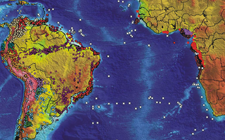
This study presents an integrated analysis of the petroleum systems of the Espírito Santo basin, eastern Brazil, based on geochemically oriented spec surveys and other geochemical studies that were recently performed by Geochemical Solutions International (GSI). The goal of this project is to provide a consistent and objective analysis of the petroleum systems of that basin to be used as an exploration tool.
The spec surveys in which this work is based include a piston coring campaign, which collected 100 cores, a natural seepage slick remote sensing project utilizing fourteen RADARSAT images in the area (seven images from spring season and seven from winter), geochemical data pertaining to crude oil and potential source rock samples representing the major fields, and a basin modeling study performed along a dip line in the basin.
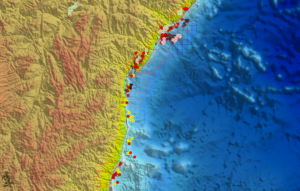
The piston core study was designed to identify sites of oil and gas seeps in the offshore Espirito Santo Basin. Results obtained from the analysis of one hundred (100) cores collected on ANP blocks BM-ES-1, and BM-ES-2 have been documented in an interpretative final report describing the presence/absence of petroleum hydrocarbons in and their geochemical characteristics. This approach has been employed successfully in various offshore petroliferous basins including the northern Gulf of Mexico, West Africa and in parts of Latin America.
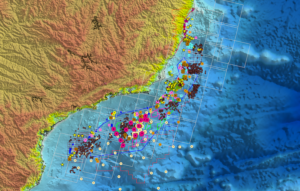
The principal results of the analysis of fourteen RADARSAT-1 W-1 images acquired from July to November 1998 provide an overview of the present-day charge of petroleum to the sea floor in the area of the Espírito Santo region. Seepage slicks observed in the Espírito Santo basin were ranked, taking into account confidence levels for tectonic setting, temporal persistence and predominant environmental conditions. Digital image processing techniques (shading and color draping) were also applied to bathymetric data of the study area in order to enhance subtle features of sea-floor topography. In addition, digital image processing techniques (shading and color draping) applied to a regional structure-contour map of the top of the evaporites were used to enhance tectonic information that may not be otherwise discernible. Major tectonic features highlighted by Cainelli and Mohriak (1998) in the project area were overlaid on the color-draped bathymetry and the structure-contour map of the top of the evaporites converted to raster format.
The remote sensing study also used modeled petroleum migration routes in order to provide insights into the origin of detected seepage slicks. GEOCHEMICAL SOLUTIONS INTERNATIONAL has undertaken the task of modeling a regional cross-section in the Campos Basin, Brazil, with the main goal of understanding the factors controlling the petroleum systems in the basin under a numerical modeling perspective. In order to have a better view of the functioning of such systems, the following main aspects have been addressed: 1) location and evolution of petroleum kitchen areas; 2) timing of petroleum generation, expulsion and migration; 3) migration pathways, accumulation and losses; 4) oil and gas compositions.
Forty-five crude oil samples from 31 wells have been analyzed using state-of-the-art oil fingerprinting techniques to evaluate the major factors governing oil quality and quantity including: (1) source facies, (2) thermal maturity, (3) distance of migration from source to trap, (4) extent and timing of biodegradation, and (5) degree of oil mixing. Oil geochemistry is a fundamental component of any regional exploration and production program. It can be used to determine the number of discrete sources in a basin and their respective stratigraphic and aerial distribution, source age, lithology, depositional environment (marine, non-marine, lacustrine) and thermal maturity. Areas with overlapping petroleum systems can be identified in relation to possible oil mixing from two or more sources. Mapping source-related oil families is the first step toward understanding and predicting the lateral extent of oil fields and regional oil quality variations in different parts of the basin.
The results of these individual studies have been integrated in a petroleum systems context to define the principal source rocks and kitchen areas, migration pathways and hydrocarbon compositions expected for the Espírito Santo basin.