Piston Coring Survey
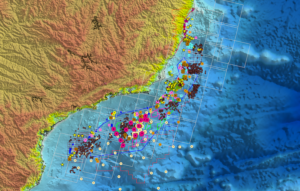
A series of seabed piston coring surface geochemical studies to identify sites of oil and gas seeps in the offshore Santos Basin of Brazil have been conducted by GEOCHEMICAL SOLUTIONS INTERNATIONAL (GSI). These non-exclusive, multi-client surface geochemical projects were developed by GSI to assist in the evaluation of the hydrocarbon potential of deep-water Brazilian marginal basins. This approach has been employed successfully in various offshore petroliferous basins including the northern Gulf of Mexico, West Africa and in parts of Latin America. In the Santos Basin, 500 cores have been acquired in water depths ranging from 100 m up to 3,000 m.
Several attributes of the Santos Basin favor the use of piston coring for regional hydrocarbon charge risk-assessment and source evaluation: (1) The existence of prolific source rocks, (2) Ongoing oil and gas generation and migration, and (3) The widespread occurrence of salt diapirs and faults that can act as vertical conduits for hydrocarbons from the subsurface to the seafloor. Offshore basins with these characteristics are most likely to exhibit a surface expression of hydrocarbon accumulations. Recently, the RJS-539 well, drilled in a water depth of 1,595 m, discovered an accumulation of light oil. The recoverable reserve of this discovery, based upon preliminary studies, is estimated in 600/700 millions of barrels of oil equivalent.
The majority of the piston core samples have been acquired within ANP blocks available for exploration. Core locations were selected from seismic data and seafloor sidescan sonar mosaics provided by Petrobras. Geochemical analysis of the cores was performed at the Center of Excellence in Geochemistry (CEGEQ) in Rio de Janeiro.
The results have been documented in an interpretative final report describing the presence/absence of petroleum hydrocarbons in piston cores and their geochemical characteristics. The reports contain maps showing distributions of key geochemical properties, highlighting sites of geochemical anomalies integrated with high-resolution sub-bottom profile of 3.5 KHz. In addition, hydrocarbon seeps encountered have been correlated with known accumulations using geochemical data for selected Santos Basin oils.