Integrated Study of The Petroleum Systems
The Santos Basin is located along the southeastern Brazilian coast, adjacent to the states of Paraná, São Paulo and Rio de Janeiro, Brazil's most industrialized region. Spanning a total area greater than 300,000 km2 up to 3,000m depth, it is the largest of Brazil's marginal basins. Five oilfields along the southern basin margin and the Merlusa gas condensate field account for an original BOEP of approximately 150 million barrels.
Geochemical Solutions International (GSI) is offering an integrated assessment of the Santos Basin petroleum systems in a study entitled Petroleum Systems of the Santos Basin. The study employs a varied technical approach consisting of:
Analysis of 37 Radarsat-1 images to detect sea surface oil slicks
Analysis of 500 sediment cores to detect oil seepage at the seafloor
2D basin model to evaluate hydrocarbon charge and timing of migration
Geochemical analysis of 33 sub-surface oils to characterize oil quality
Geochemical analysis of 10 wells to characterize source quality and thermal level
The results have been interpreted to define active petroleum system(s), subsurface migration pathways, and hydrocarbon compositions expected in this region. This information is relevant to the regional assessment of deep-water blocks, including those offered as part of the ANP Round 4 bid round.
This non-exclusive, multi-client study is available immediately. The data products include technical as well as interpretative reports, distributed on both printed and digital media.
A technical description of the individual data sources is included below:
Detection of sea bed oil seeps
Seeping oil and gas in seabed sediments can be used evaluate hydrocarbon charge at both regional and sub-regional (prospect) scales. A total of 500 sediment cores have been collected at potential oil and gas seepage sites throughout the Santos basin in ANP blocks BM-S-2, BM-S-3, BM-S-7, BM-S-8, BM-S-9 and BM-S-10. Geochemical analysis indicates the presence of hydrocarbons at various locations that originate from the deep subsurface. These occurrences are associated almost exclusively with deformation and uplift of the near-surface sediments, which presumably represents conduits along which hydrocarbons migrate to the surface. A correlation with oils from nearby wells defines the hydrocarbon source facies and suggests subsurface migration pathways.
Detection of natural sea surface oil slicks
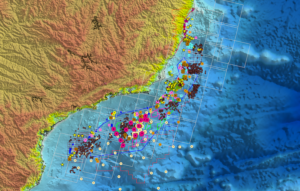
Detection of natural sea surface oil slicks in satellite images can be used as independent evidence for present-day hydrocarbon generation and migration. Thirty-seven RADARSAT-1 W-1 images acquired from July to November 1998 and August to October 1996 have been analyzed for the presence of natural sea surface slicks. Slick features were identified using a classification algorithm and ranked according to tectonic setting, temporal persistence and predominant environmental conditions. The results are presented over digitally enhanced bathymetric maps as well as a structure-contour map of the top of the evaporites in order to relate the surface slick to major subsurface structural features. 2D-seismic data and piston coring results are used to identify possible locations of hydrocarbon emanations resulting in the slick feature.
2D Basin model
Numerical modeling has become an integral part of exploration strategy, which simulates basin evolution and petroleum generation, expulsion and migration in a physically consistent manner. GSI has teamed with BEICIP-FRANLAB to perform a 2D compositional basin model of a regional geologic cross-section in the central Santos Basin using the Temispak 2D software. The model addresses the following aspects of regional petroleum systems: 1) location and evolution of petroleum kitchen areas; 2) timing of petroleum generation, expulsion and migration; 3) migration pathways, accumulation and losses; 4) oil and gas compositions.
Geochemical analysis of oil and source rock samples
Thirty-three oil samples from ten wells have been analyzed using state-of-the-art fingerprinting techniques to evaluate the major factors governing oil quality and volumes including: (1) source facies, (2) thermal maturity, (3) distance of migration from source to trap, (4) extent and timing of biodegradation, and (5) degree of oil mixing. In addition, geochemical characterization of discrete source rock intervals from ten wells forms the basis for oil-source correlations.
The results of these individual studies have been integrated in a petroleum systems context to define the principal source rocks and kitchen areas, migration pathways and hydrocarbon compositions expected in the Santos Basin.