Integrated Study of The Petroleum Systems
GEOCHEMICAL SOLUTIONS INTERNATIONAL (GSI) is offering an integrated study of the petroleum systems of the Camamu basin, eastern Brazilian margin, based on a geochemically oriented spec survey that were recently performed and other geochemical projects. The goal of this study is to provide a consistent and objective analysis of the petroleum systems of that region to be used as an exploration tool.
The Camamu-Almada Basin is located in the southern portion of the coast of Bahia State. The Camamu Basin lies also on the coastal plain. The Jacuípe and Recôncavo basins bound it to the north across the transfer zones of Itapoã and Barra, respectively. The Itacare high separates the Almada and Camamu basins. The Olivença High separates the Almada Basin of the Jequitinhonha Basin. These two basins comprise an area of 22,900 sq km until water depths of 3,000m. The Camamu basin covers 16,500 sq km and the Almada basin covers 6,400 sq km. Five discoveries of oil and gas have been made in the Camamu Basin - two onshore (Morro do Barro/gas and Jiribatuba/oil), and three offshore (1-BAS-64/oil, the 1-BAS-97/gas, and the recent discovery of the 1-BAS-128/gas).
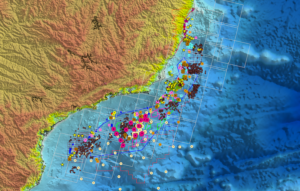
The spec surveys in which this work is based include a piston coring survey in the offshore area (BM-CAL-4), an oil data from 1-BAS-64 and a 2-dimensional basin model. The piston core study involved the collection and analysis of 50 cores from block BM-CAL-4, selected based on available 2D seismic data. The results of this study have been documented in an interpretative final report, which describes the presence/absence of petroleum hydrocarbons and their geochemical characteristics. The report contains maps showing distributions of key geochemical properties, highlighting sites of geochemical anomalies.
Besides the piston coring survey a crude oil sample derived from 1-BAS-64 well has been analyzed using state-of-the-art oil fingerprinting techniques to evaluate the major factors governing oil quality and quantity including: (1) source facies, (2) thermal maturity, (3) distance of migration from source to trap, (4) extent and timing of biodegradation, and (5) degree of oil mixing. Oil geochemistry is a fundamental component of any regional exploration and production program. It can be used to determine the number of discrete sources in a basin and their respective stratigraphic and aerial distribution, source age, lithology, depositional environment (marine, non-marine, lacustrine) and thermal maturity. Areas with overlapping petroleum systems can be identified in relation to possible oil mixing from two or more sources. Mapping source-related oil families is the first step toward understanding and predicting the lateral extent of oil fields and regional oil quality variations in different parts of the basin.
A two-dimensional basin modeling study is also being conducted in the Camamu-Almada Basin to provide a better understanding of its petroleum systems. The model is based on a regional W-E cross-section extending from the shallow offshore area to the deep-water province. Basin modeling has become an essential tool for petroleum exploration. It allows the explorationist an integrated, dynamic means by which to simulate basin evolution and petroleum generation, expulsion and migration. It also provides insights into fundamental questions such as: 1) where are the source rock "kitchens"? 2) what is the timing of petroleum generation, expulsion and migration for each source rock interval? 3) what are possible migration pathways from source rocks to reservoirs? 4) what is the significance of faults as migration pathways? 5) how effective must drains and seals be in order to have commercial accumulations? and 6) what are the expected oil and gas compositions in a hydrocarbon trap?
The results of these individual studies have been integrated in a petroleum systems context to define the principal source rocks and kitchen areas, migration pathways and hydrocarbon compositions expected for the Camamu-Almada Basin.