
BRIOS: Brazil Integration of Oils and SAMBA3, Understanding the Petroleum Systems
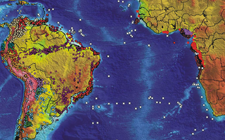
Core Laboratories has now built up extensive expertise in the regional petroleum geology of both the Brasilian and West African Atlantic Margin Basins. Recent geological studies (2001-2003) of nine Brasilian basins have established an integrated geological model for the shelfal and deepwater areas of the eastern Brasilian Margin. In the mid nineties Core completed two landmark geochemical and reservoir evaluations of the Pre Salt of West Africa. The Gabon/Congo areas were substantially updated and expanded during 2003. Recent hydrocarbon discoveries in pre-salt reservoirs have rekindled international interest within the clastic and carbonate rift and pre-rift plays along both the Brasilian and West African margins.
Core Laboratories and its technical partner Geochemical Solutions Inc. is pleased to present a proposal for detailed evaluation of the pre-salt sediments. Our objective is to undertake a detailed investigation of the sedimentological, petrographical, biostratigraphical, geochemical and petrophysical properties of the reservoirs and source horizons, integrated with an evaluation of associated seal rock lithologies and correlated with local deep-seated basement tectonic structures. A specific objective of this regional study will be to integrate well data with available seismic lines and to provide a comprehensive regional interpretation through correlation with outcrop studies and analog models.
The study will be performed on ditch cuttings, cores, sidewall cores and fluids from a suite of wells selected to cover the range of pre-salt facies present in the region. In addition, a suite of oils (c.170 fluids) generated in pre-salt sediments will be integrated within the depositional models presented. All data formats are designed to be consistent and compatible with our existing Atlantic Margin basin studies. The primary technical objective of the proposed study is to extend the geological model of pre-salt plays established for the shelfal parts of the Atlantic Margin Basins to establish a high-resolution, fully integrated, geological model for the rift and pre-rift reservoirs and source horizons. The study will primarily focus on sediments of Berriasian to Aptian age that include a range of fluvial-continental, shallow lake and resedimented deep lake facies. Interpretation of data will include high-resolution biostratigraphy, geochemistry and detailed analysis of depositional environments, reservoir and seal geometries. Besides the well-documented fluvial and shallow lacustrine facies of the Atlantic Margin Basins, data from our Atlantic Margin studies (Core Laboratories, 2002/3) suggests the presence of some deeper water lake turbidite or debris flow deposits and local pre-rift Aeolian sandstones with considerable reservoir potential. In addition to detailed sedimentology, the project will include full evaluation of reservoir quality and reservoir fracturing as appropriate through detailed petrographic analysis of thin sections and macroscopic analysis of any core fracture systems. Detailed regional evaluation of the Berriasian to Aptian succession will provide the integrated geological dataset required for geological modelling and optimum reservoir description of all rift plays. Specific objectives of the study are to:
• Provide a high-resolution biostratigraphic framework for the pre-salt sediments
• Evaluate the petroleum generative system
• Provide detailed reservoir description of the pre-salt succession
• Provide full integration of sedimentological and biostratigraphical data
• Provide AVO modeling of a select number of key wells.
• Provide a regional SEAL evaluation for the Pre Salt reservoirs.
• Provide a digital database of laboratory and well data, including electric logs for the area;
• Provide a browser (HTML) version of the dataset and report.
Deliverables include interpretive volumes for each Margin documenting results and conclusions synthesized into regional interpretations. All laboratory and well log data will be provided in digital format and in a standard well browser format (HTML) compatible with company Intranets.